Passive Mine Water Treatment System
Trihydro is using a passive system to treat mine water with elevated metal concentrations at a legacy mining site in Southwest Colorado.
Trihydro and its predecessor, Alloy Group’s Engineering and Consulting Division (acquired in 2024), provide environmental services for the large, complex, legacy mining site in the San Juan Mountains. Our team’s solution navigates multiple site challenges, such as extreme winter weather and environmental concerns.
Site Challenges
The site faces multiple challenges. Extreme winter weather creates significant safety hazards and logistical difficulties. Furthermore, the site borders a high-quality trout stream and extends into a neighboring mountain with its own mine workings, requiring careful environmental management to protect the surrounding ecosystem. Adding to the complexity, high concentrations of metals are present in the mine water that drains to an on-site adit, which discharges water with seasonal flow variations ranging from 600 to 1,300 gallons per minute (gpm).
Implementing a Passive Treatment Solution
Due to environmental concerns, regulators and stakeholders were seeking viable passive treatment solutions for numerous abandoned mining sites. Trihydro addressed this need by operating two demonstration-scale passive water treatment systems, treating a combined flow of about 610 gpm.
Passive treatment offers a distinct advantage over conventional methods. It uses naturally occurring elements and biogeochemical environments to remove metals from mine water. This translates to less reliance on external energy sources, chemicals, and manpower for operation.
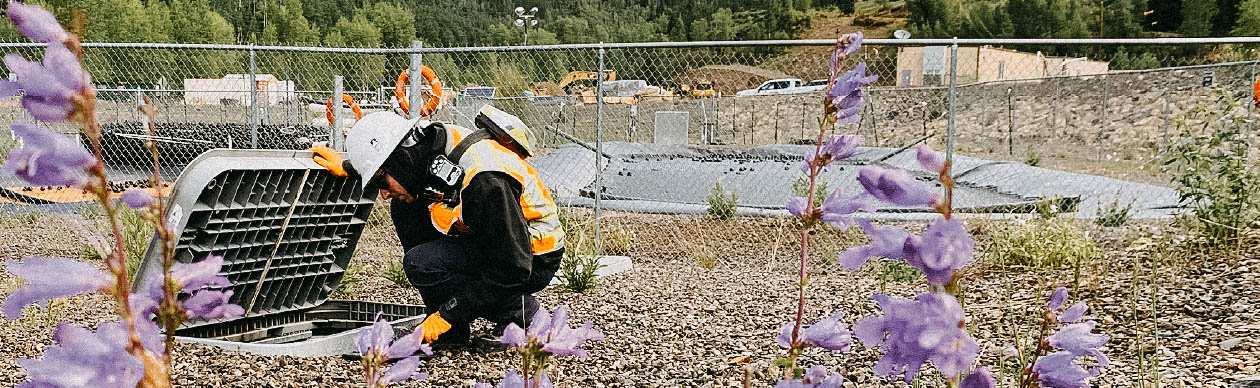
Trihydro diverted the adit water through a series of ponds to evaluate the optimal passive treatment system for contamination. These engineered ponds include both horizontal and vertical flow wetlands. Native plants and various organic materials within these wetlands create a biogeochemical environment ideal for metal removal. This process involves sulfate-reducing bacteria, which generate sulfide that binds to dissolved metals and creates alkalinity, raising the overall pH level of the water. The only active steps in the entire system involve initial aeration and the addition of a coagulant.
The demonstration systems are equipped with instruments connected to remotely accessible data loggers and a Supervisory Control and Data Acquisition system for continuous monitoring.
Trihydro designed a full-scale passive water treatment system based on the data gathered from the demonstration-scale systems. Construction of the full-scale system is underway.
Managing Site Operations, Maintenance, and Monitoring
Beyond water management and treatment, Trihydro’s role encompasses site operations, maintenance, and monitoring. This includes groundwater and surface water monitoring and sampling, stormwater management, settling pond monitoring and maintenance, and site maintenance (such as access road maintenance, fencing repair, etc.).
Implementing Site Improvements
Trihydro also plays a crucial role in designing, overseeing, and implementing improvements across the site. The project team comprises process engineers, civil engineers, environmental engineers, geochemists, geologists, health and safety experts, and field technicians. These specialists bring a wealth of expertise in areas like process and environmental engineering, civil engineering and design, bench and pilot-scale testing, operation and maintenance implementation, construction oversight, and health and safety management.